Pickup Music Review 2026: The Modern Innovator for Intermediate Players (Now with Bass and Piano)

Disclosure: I’m a Pickup Music affiliate, which means I earn a small commission if you sign up through my links, at no extra cost to you. Pickup Music also gave me six months of complimentary access in October 2025 to complete this in-depth review. That doesn’t change what I write — I’ve been paying attention to this app since long before I became an affiliate, and this review is based on my own experience across every device I own.
Quick summary and verdict
Score: 9.5/10 🌟
Pickup Music is still the app I recommend most often to intermediate players who feel stuck at a plateau. Since I first wrote about it in August 2025, it has quietly become a much more complete product: guitar, bass, and now piano, a proper desktop and browser experience, a redesigned notation and video player, a new AI analysis feature under Coaching, an active community with a public product roadmap, and optional 1:1 private lessons via til.co.
At a glance:
• Price: $29.99/month or $179.99/year (works out at ~$14.99/month on the annual plan). 14-day free trial. 60-day money-back guarantee for first-time customers.
• Instruments: Guitar, bass, and piano — with drums teased for 2027.
• Platforms: Web (any modern browser), iPad, iPhone iOS app. No Android app that I can see.
• Best for: Late-beginner to advanced players who want structured pathways, human video feedback from real instructors, and a community that actually influences the roadmap.
The two things holding it back from a 10 are the same two things I flagged in 2025: still no real-time note recognition while you play (the new AI analysis is async, not real-time), and the library keeps evolving in ways that can make comparisons tricky. Neither is a dealbreaker.
Who this app is for (and not for)
Pickup Music has always known its audience, and if anything the fit is sharper now.
It’s a great fit if you are:
• A late-beginner who has learned some open chords and wants a clear ladder to follow through intermediate and into advanced.
• An intermediate guitarist stuck at a plateau — you can play plenty of songs but you don’t really understand the fretboard, you’re bored of scale boxes, and your soloing sounds like everyone else’s.
• A returning player who used to play well and wants a structured way to rebuild without going back to “here’s an E chord”.
• A bass player who wants a serious dedicated pathway rather than being an afterthought on a guitar app.
• A guitarist who wants to add piano without paying for a second subscription.
• Someone who values feedback from real humans, not just gamified progress bars.
It’s probably not right if you are:
• An absolute beginner who wants fast dopamine hits from a game-style app that plays a song alongside you as you fumble through your first chord changes. Yousician, Simply Guitar, and the Gibson App do that better.
• A classical guitarist focused on standard notation and repertoire. Tonebase is more your world.
• Someone who needsreal-time pitch feedback while you play. Pickup Music’s AI analysis works on uploaded video, so it can’t tell you off in the moment when your G is actually an F#.
• Android-only on mobile. There’s a web app but no dedicated Android app at the time of writing.
How the app teaches
The core teaching model is one of the smartest in the space: structured pathways plus real human feedback plus a supportive community.
Here’s how the layers stack together in practice:
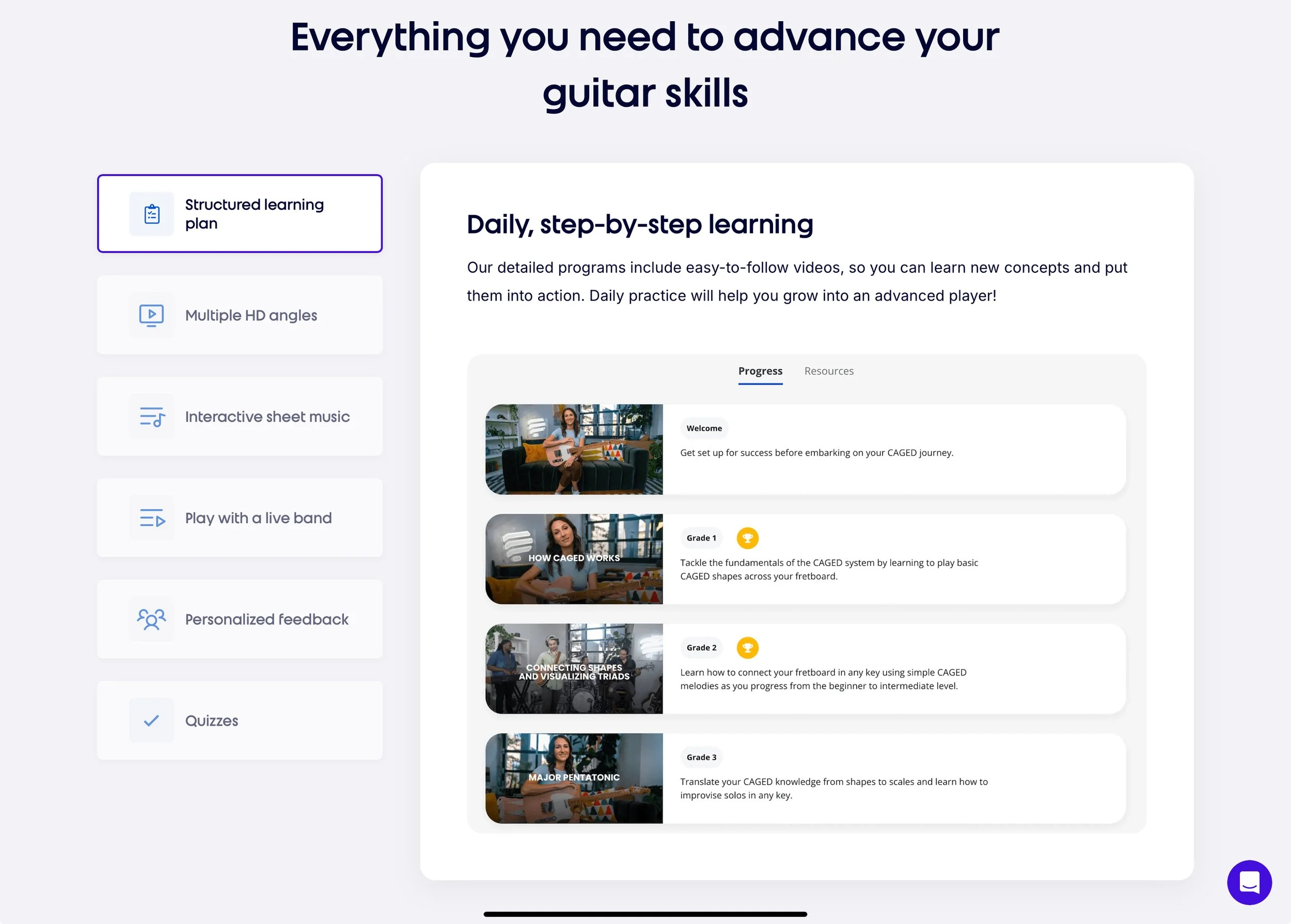
1. Personalised Learning Pathways are the backbone. You pick a pathway (Foundations, CAGED, Blues, Neo Soul, Jazz, Country, Fingerstyle — there are now 20 for guitar alone), work through grades in order, and end each grade with a quiz and a performance piece.
2. The interactive notation and video player (redesigned in December 2025) is where you spend most of your practice time. Video on one side, TAB or standard notation on the other, playback-speed and looping controls, and a real-time virtual fretboard underneath.
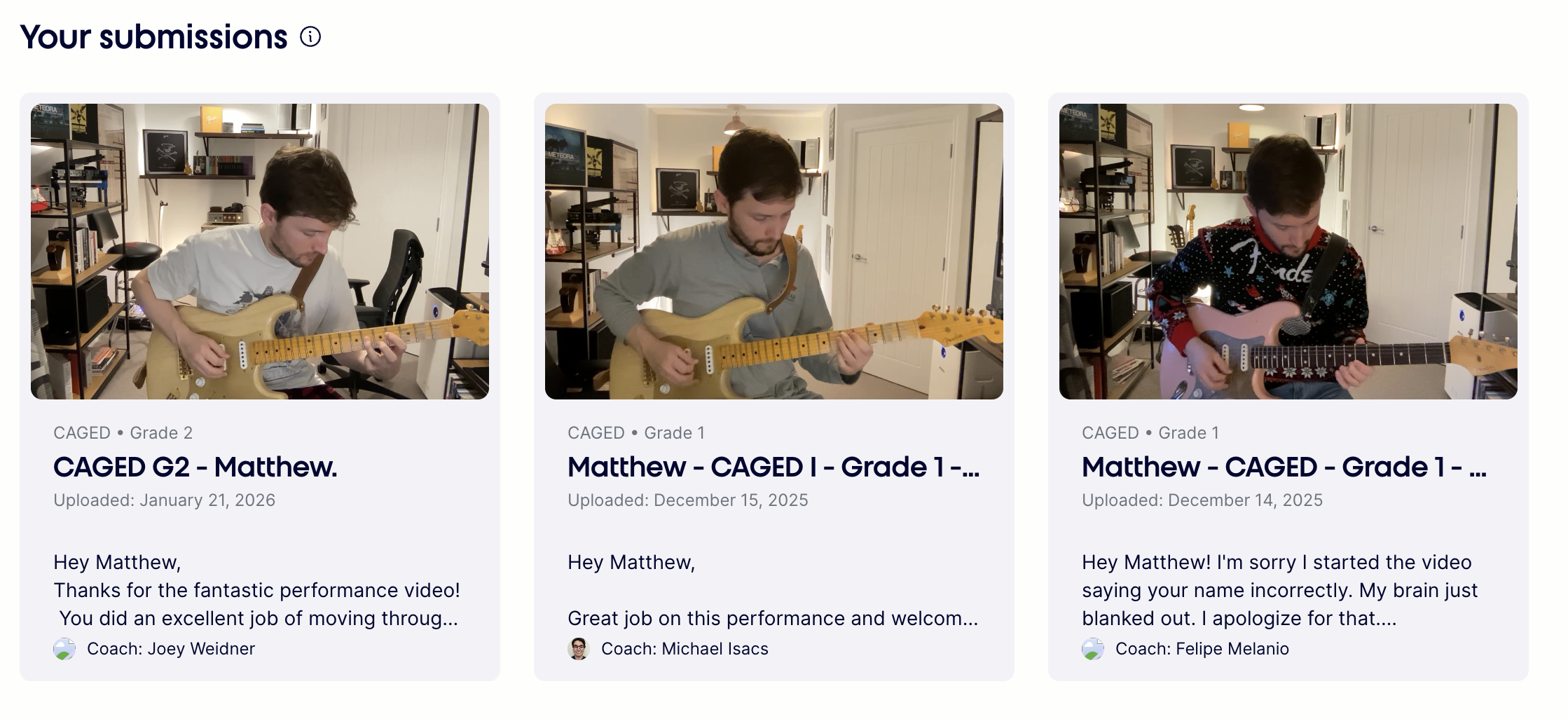
3. 1:1 video feedback from expert instructors is included in your membership. You upload a short video, an instructor reviews it, and you get a personalised video reply. The one caveat: this is now capped at one submission per grade, which is a fair limit given demand but worth knowing up front. This is my favourite feature by far that I have made the most of when completing grades.
4. AI analysis (new under the Coaching tab) gives you fast automated feedback in between human reviews. Pickup Music themselves describe it honestly: “It can make mistakes, so treat it as a guide. It’s generally more accurate for beginners than advanced players. AI feedback is not a replacement for expert human coaching.” It’s hit a few bumps in the road when I’ve tested it but it’s a nice think to experiment in you want almost immediate feedback on your playing.
5. Weekly live group lessons happen across all three instruments and are recorded, so you can catch up later.
6. Optional paid 1:1 private lessons through the til.co partnership let you book time directly with Pickup Music coaches and guest instructors, including some genuinely well-known players.
The thing that ties this all together is the community. It’s now a proper Circle-style forum at community.pickupmusic.com, with per-instrument channels, live-lesson channels, “Share your playing”, “Prizes for Progress” (the monthly gear giveaway is still running), and — this is one of my favourite touches — a public Product Roadmap where members vote and comment on what should ship next.
Key features and experience
Here’s what’s actually inside the membership right now:
• 20 guitar Learning Pathways, organised into a Core Curriculum (Beginner → Late Beginner → Intermediate → Late Intermediate), Skill Pathways (CAGED, CAGED 2, Triads, Music Theory, Soloing), and Style Pathways (Blues, Jazz, Country, Neo Soul, Metal, Gospel, Funk, Bluegrass, Fingerstyle, Rock, Acoustic).
• A full Bass instrument with its own Foundations ladder (Beginner → Late Intermediate) plus Rock, Funk, Jazz, Blues, walking-bass, slap and ghost-note pathways. 17 dedicated courses at the time of writing.
• Piano as a full third instrument — rolled out to all members in June 2026. Foundations content plus a new “NEW”-badged Jazz Piano pathway with Rob Araujo.
• Artist Series (formerly “Masterclasses”) — deep-dives with players like Melanie Faye, Daniel Donato, John Storie, Seth Rosenbloom, and more. About 26 items across styles for guitar; more being added in bass and piano.
• 500+ original songs, 100+ essential-lick packages, and 100+ five-minute lessons (these are Pickup Music’s current stated figures — the count evolves as content is refreshed and re-categorised).
• 97 instructors on the guitar side alone.
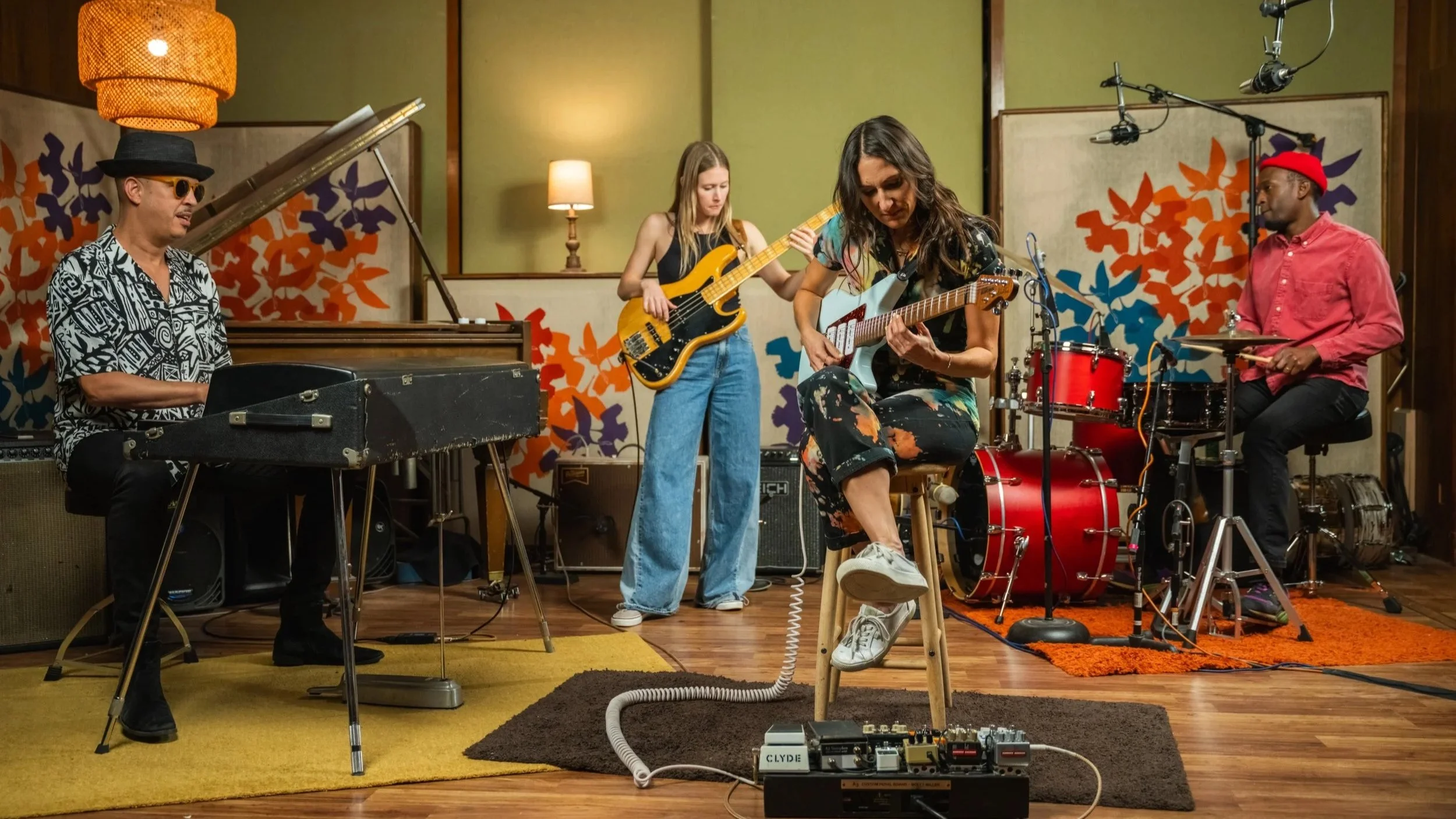
• Customisable backing tracks — the evolution of the “live backing band” idea, where you can remove your own instrument’s part from the mix (“No guitar”, “No bass”, “No piano” toggles).

• Custom lesson playlists — build and save practice sequences (added November 2025).
• Interactive notation and video player with adjustable layout, playback-speed and looping controls, keyboard shortcuts, virtual fretboard, left-handed flip mode, and TAB / standard-notation toggle.
• iOS app — 4.9 stars with 965 ratings on the App Store. Requires iOS 15.1 or later.
• Web appacross mobile, tablet, and desktop browser — no dedicated Android app that I’ve been able to find.
• Weekly live group lessons across all three instruments, all replayed in-community.
• Monthly “Prizes for Progress” gear giveaway — post your progress video, be in the draw.
• 1:1 video feedback included, capped at one submission per grade.
• AI analysis (async, upload a video, get automated feedback on strengths, weaknesses, and a suggested practice plan).
• Private/small-group lessons via the til.co partnership — a paid add-on, separate from your membership. Guest classes so far have included Snarky Puppy’s Bob Lanzetti, bassist Nick Campbell, and guitarist Ruben Wan.
• Community forum with a public Product Roadmap you can actually vote on.
Strengths
Five things Pickup Music genuinely does better than most of its competitors:
• A coherent, calm UI across web and iOS. The redesign that landed in 2025 removed a lot of the clutter I used to see on the old platform, and the new player just gets out of your way when you’re practising.
• Real depth across three instruments in one subscription. Very few apps give you serious guitar, bass, and piano content for a single price. If you play more than one instrument, or you live with someone who does, the value equation shifts sharply.
• Human feedback is still included as standard. Even with the one-per-grade cap, this is the feature I recommend Pickup Music for above anything else. The video replies I’ve had have been personal, considered, and genuinely encouraging — nothing like the generic “well done, try again” you get from most apps.
• A community that actually shapes the product. The public Product Roadmap board is not just a suggestion box — features get built, and members are told when. I’ve pitched ideas myself and had them acknowledged by the team.
• Independent and musician-run. Pickup Music is fully bootstrapped, built by working musicians, and it feels like it. The style leans toward contemporary, groove-based, “feel” playing rather than shred-heavy or theory-only content.
Limitations and trade-offs
Four things it’s fair to be honest about:
• No real-time note recognition. If you want the app to tell you in the moment that you’ve bent to G# rather than G, Pickup Music can’t do that yet. AI analysis handles this asynchronously, but it’s not the same thing as playing along and being corrected live.
• Video feedback capped at one submission per grade. Fair given demand, but a change from earlier days when submissions felt more generous.
• No Android app that I can find. iOS and web only. If you’re an Android-only household, this is worth checking before you sign up.
• If you were a pre-May-2025 legacy member, your old progress didn’t carry over when Pickup Music retired the legacy site in December 2025. Returning users had to reset their password on my.pickupmusic.com and manually mark completed lessons again.
Pricing, trials and value for money
Pricing is unchanged from a year ago and remains one of Pickup Music’s stronger arguments:
• Monthly plan: $29.99/month
• Annual plan: $179.99/year, which works out at ~$14.99/month effective — Pickup Music labels this a 50% saving versus monthly.
• Free trial: 14 days.
• Money-back guarantee: 60 days for first-time customers.
• Cancellation: self-serve on your account page. No charge if you cancel during the trial.
There’s no lifetime plan, no family plan, and no student tier that I could find.
A note for UK & European-based readers: the pricing page presents in USD by default. I haven’t seen a GBP or EUR price switch on my own account, so factor in whatever your card charges for currency conversion and non-sterling transactions. On my UK card the annual plan lands in the £140–£145 range in practice.
On value for money, Pickup Music themselves make a fair comparison in their FAQ: a private in-person teacher at $50 a lesson runs you around $2,600 a year, versus $180 a year for Pickup Music — roughly 50p a day. That’s still a fair frame, and it’s the frame I’d use with any adult learner weighing up the annual plan.
Two things to remember are extras, not included in your membership:
• 1:1 private lessons via til.co are a separate paid booking.
• Any Google Play or Android app — doesn’t currently exist as far as I can tell, so budget for iOS or a laptop/tablet browser if you’re an Android user.
How it fits into a real practice routine (tried and tested) - are you ready to pickup?
Here’s a realistic weekly rhythm I’d recommend for an adult learner with three to five practice sessions a week:
Weekly template (about 30–45 minutes per session):
1. Warm-up (5 min): a familiar 5-minute lesson or a lick pack you’re refining.
2. Pathway lesson (15–20 min): work through your current grade in one Learning Pathway. Don’t move on until you can play the exercise cleanly at practice tempo.
3. Song or performance piece (10 min): apply what you’ve learned to one of Pickup Music’s original songs or your own repertoire.
4. Feedback loop (weekly): once a week, film a short video of yourself playing that grade’s performance piece and upload it either for AI analysis (fast automated feedback) or your 1:1 video feedback submission (once per grade — save this for the piece you’re most stuck on).
5. Live lesson or community (weekly): join or watch a replay of a live group lesson, and post a short update in the community.
If you like this, pair it with:
• A metronome app or something like Soundbrenner for locking in your timing.
• A music theory tool like Teoria or Musictheory.net if you want to go deeper on the theory side beyond what Pickup Music covers.
• Tonebase if classical guitar is also part of your life — I use both, and they’re aimed at very different players.
Bottom line and recommendation
Pickup Music has spent the last year turning almost every one of my 2025 wish-list items into shipped features. Desktop and browser? Done. More content? Done, materially. Bass as a real instrument? Done. A native iOS app? Done, and rated 4.9 across nearly 1,000 reviews. AI-assisted feedback? Not the real-time version I asked for, but a thoughtful async version that’s honest about its limits.
Try it if:
• You’re a late-beginner or intermediate player who is stuck and wants a modern, personalised, community-backed way to break through the plateau.
• You want structured pathways plus human feedback plus a genuinely useful community, all in one subscription.
• You play (or want to play) more than one of guitar, bass, or piano.
Watch out for during the free trial:
• Try both the AI analysis and the 1:1 video feedback so you understand what each is for.
• Browse a full pathway to check the teaching style suits you.
• Sit in on a weekly live lesson — it’s often the moment people realise Pickup Music is more than a video library.
• Check the experience on the device you’ll actually practise with — iPhone, iPad, or browser.
• If you were a pre-May-2025 member, know that your old progress didn’t migrate and you may need to reset your password.
Skip it if:
• You want real-time pitch feedback while you play.
• You’re an absolute beginner who prefers game-style apps.
• You’re Android-only on mobile.
If you want to try Pickup Music for yourself, you can grab the 14-day free trial and 60-day money-back guarantee here.
And if you’re weighing this up against other apps I’ve reviewed, my Gibson App review is a good complementary read — Gibson App is where I’d send a total beginner, and Pickup Music is where I’d send them next.
YouTube review coming soon - subscribe to my newsletter to be alerted when it's posted.
Socials: Facebook | Instagram | YouTube
This review reflects Pickup Music as of August 2026. Features, pricing, and content counts change often — I’ll refresh this again as the platform evolves. AI was used in the process of writing this blog post but only to help structure and organise the content.












FAQs
Is Pickup Music worth it in 2026? Yes, for late-beginner and intermediate players who want structured pathways, human video feedback, and a supportive community. It’s less compelling for absolute beginners or players who need real-time pitch feedback.
How much does Pickup Music cost? $29.99/month or $179.99/year (~$14.99/month effective on the annual plan), with a 14-day free trial and 60-day money-back guarantee for first-time customers.
Does Pickup Music teach bass and piano? Yes. Bass launched fully in August 2025 and piano rolled out to all members in June 2026. All three instruments are included in a single membership.
Does Pickup Music have real-time note recognition? Not currently. There’s a new AI analysis feature under Coaching that gives automated feedback on uploaded videos, but it isn’t real-time pitch detection while you play.
Is there a Pickup Music Android app? Not at the time of writing. There’s an iOS app (App Store rating 4.9, 965+ reviews) and a full web app that works in any modern browser.
How does the video feedback work? You upload a short video of your playing and a Pickup Music instructor reviews it with a personal video reply. It’s included in your membership but capped at one submission per grade.
Can I get 1:1 lessons with Pickup Music instructors? Yes, but as a separate paid add-on via the til.co partnership. Members can book 1:1 private lessons and small group classes directly with Pickup Music coaches and guest instructors.
What happened to the old Pickup Music site? The legacy platform was retired in December 2025. Members who signed up before 6 May 2025 need to reset their password on my.pickupmusic.com, and old lesson progress did not migrate — completed lessons need to be manually marked again.