Paul Davids Guitar Review 2026: Six Courses, No Subscription, and a New Way to Learn Soloing
Disclosure: I bought Next Level Playing with my own money in December 2023 and I still use it. Nothing in this review was arranged with Paul Davids or his team, and they haven't seen it before publication.
Quick summary and verdict
Score: 8.5/10
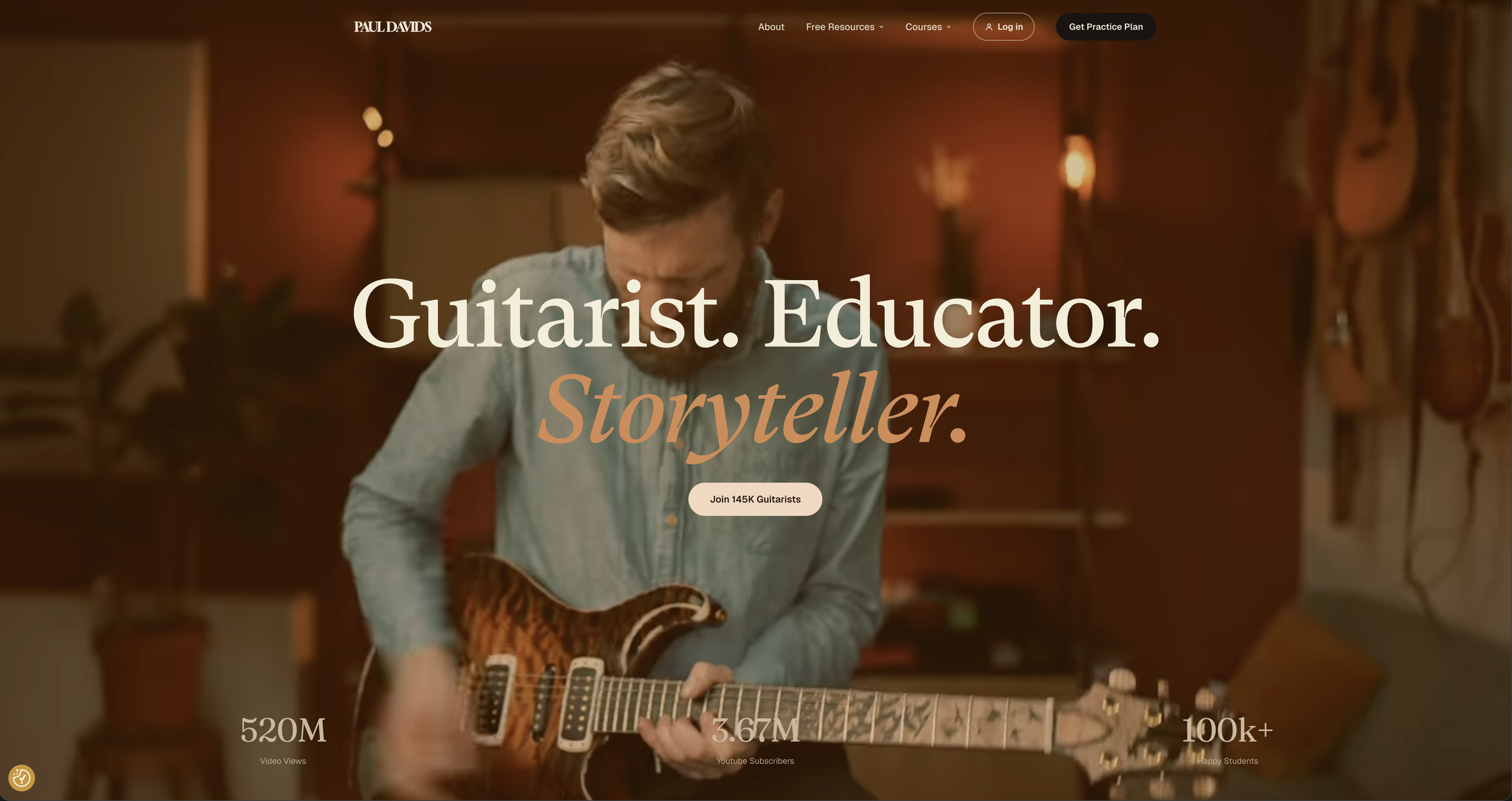
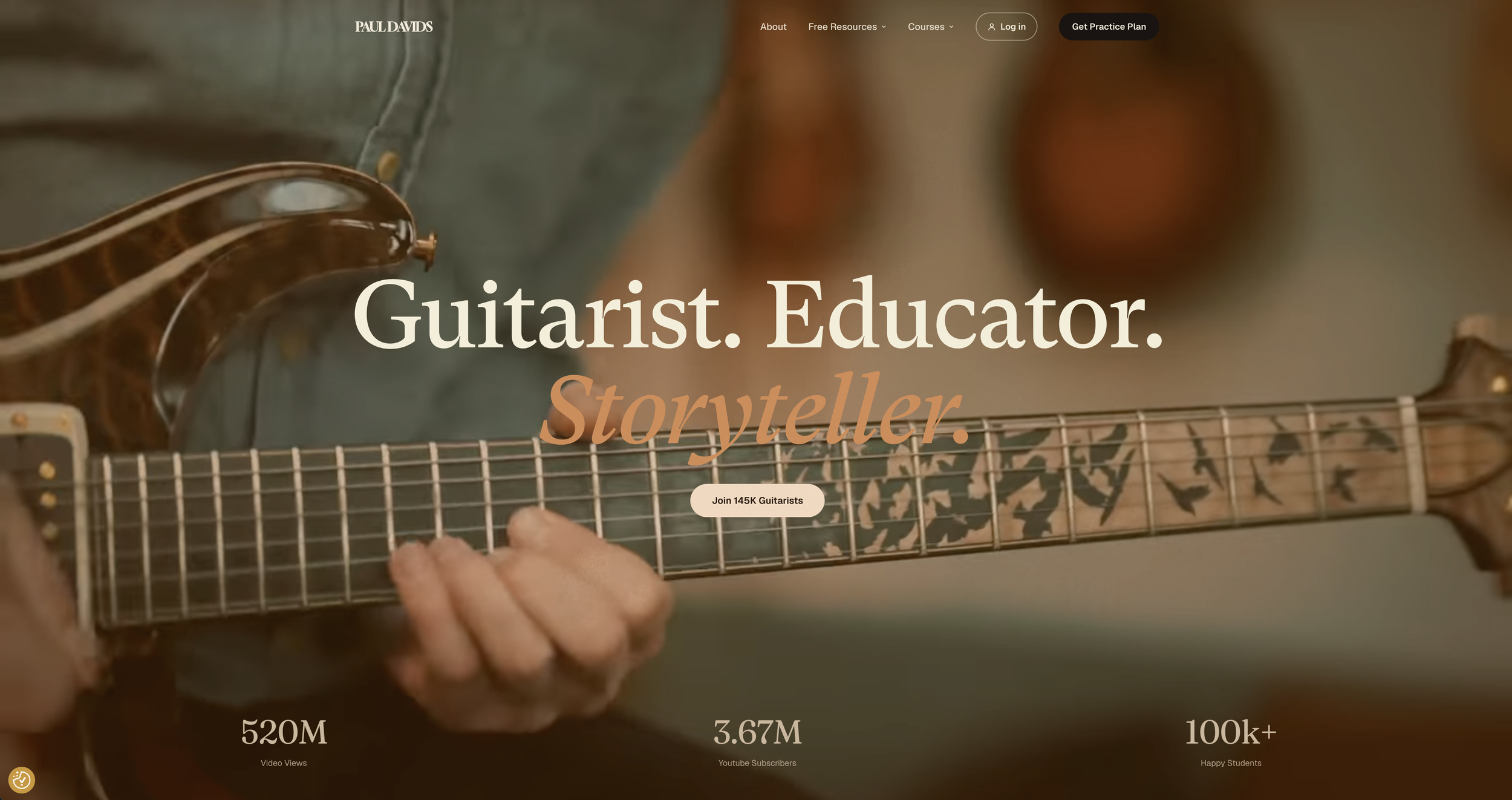
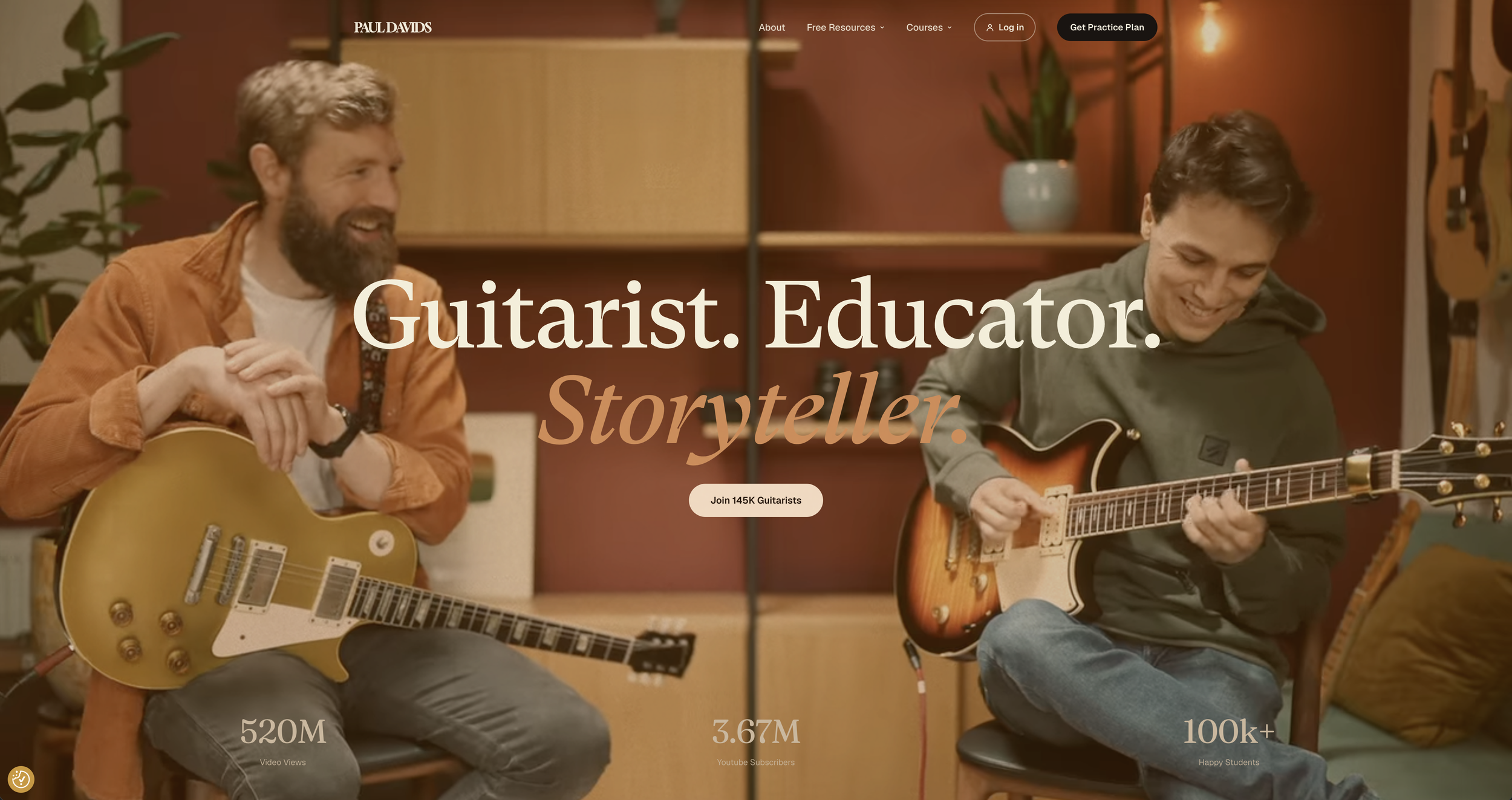
Paul Davids Guitar is a small set of pay-once video courses from one of YouTube's best-known guitar teachers. It isn't an app, a game or a giant library. It's a handful of carefully made courses, each built for one stage of your playing, and you keep them for life.
The main change in the last year is Solo School. It's Paul's first new course in more than three and a half years: an improvisation course built around the playing of David Gilmour, B.B. King, Eric Clapton, Mark Knopfler, John Mayer, Jimmy Page and Slash. There's also a short $79 theory add-on, a much bigger set of free tools on the website, and a tidier refund policy (14 days on every course).
It isn't a 9 because there's still no app or offline viewing, there's no bundle for buying several courses, and the newest course only opens for enrolment a few times a year.
At a glance:
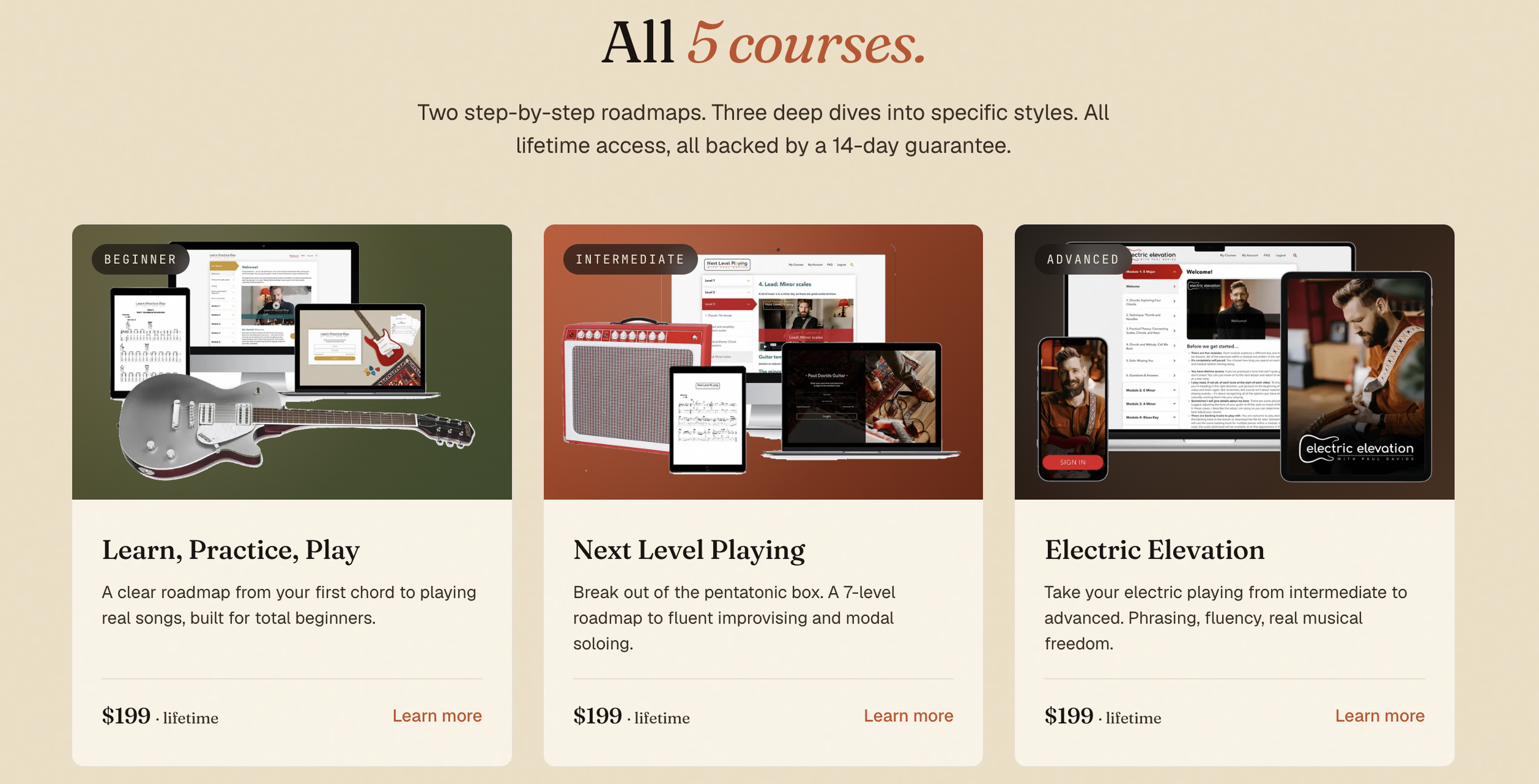
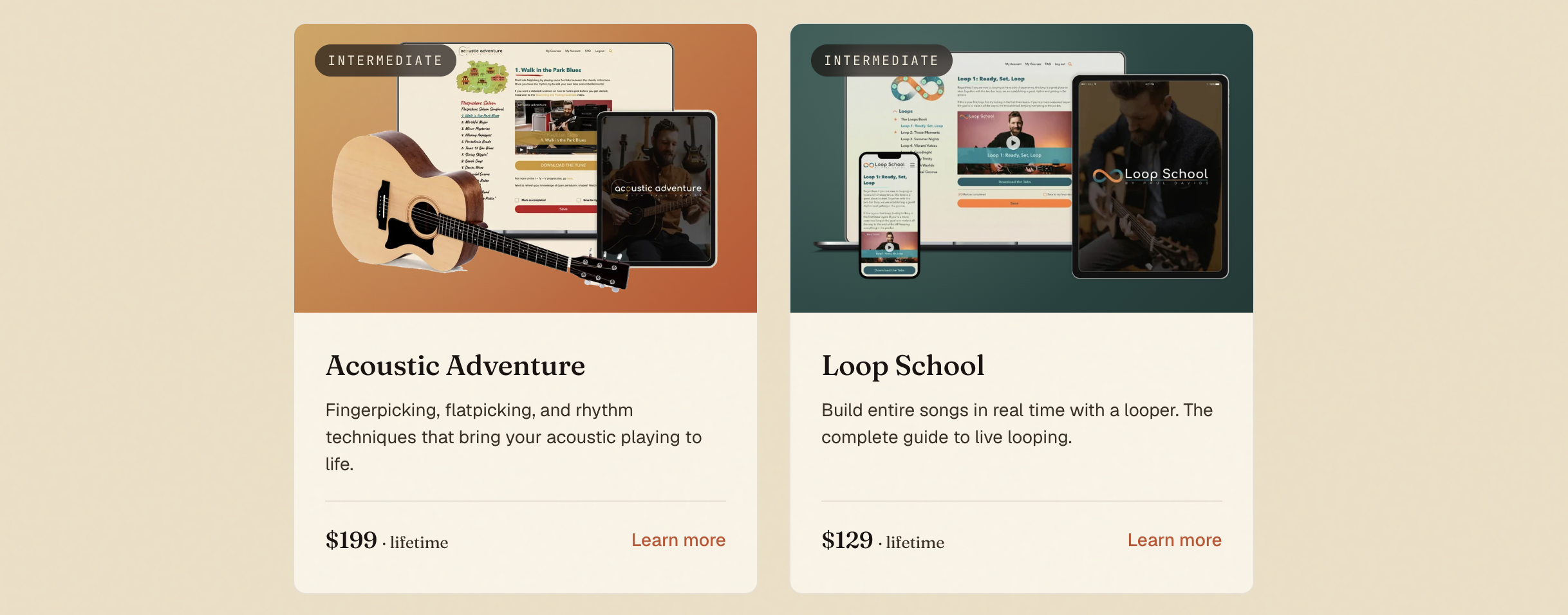
• Price: $199 per course for Learn, Practice, Play, Next Level Playing, Electric Elevation, Acoustic Adventure and Solo School, or 3 monthly payments of $79. Loop School is $129 upfront. Guitar Theory Fast-Track is $79. Everyone pays in US dollars, including UK customers.
• Free trial: no free trial. Every course has a 14-day money-back guarantee, and within that window you can swap to a different course.
• Platforms: web browser on desktop, tablet or phone. No mobile app, and no offline downloads.
• Levels: total beginner to advanced, with a separate course for each stage.
• Best for: late beginners and early intermediate players who want a clear, finite course from a teacher they already like on YouTube, and who prefer owning a course to renting a library.
Who this app is for (and not for)
Quick definitions, as I use them across all my reviews:
• Late beginner: you can play open chords and a few songs, but changing chords, strumming patterns and basic timing still take concentration.
• Early intermediate: you're comfortable with barre chords and the minor pentatonic scale, but you feel stuck in the same shapes and licks.
It’s a great fit if you are:
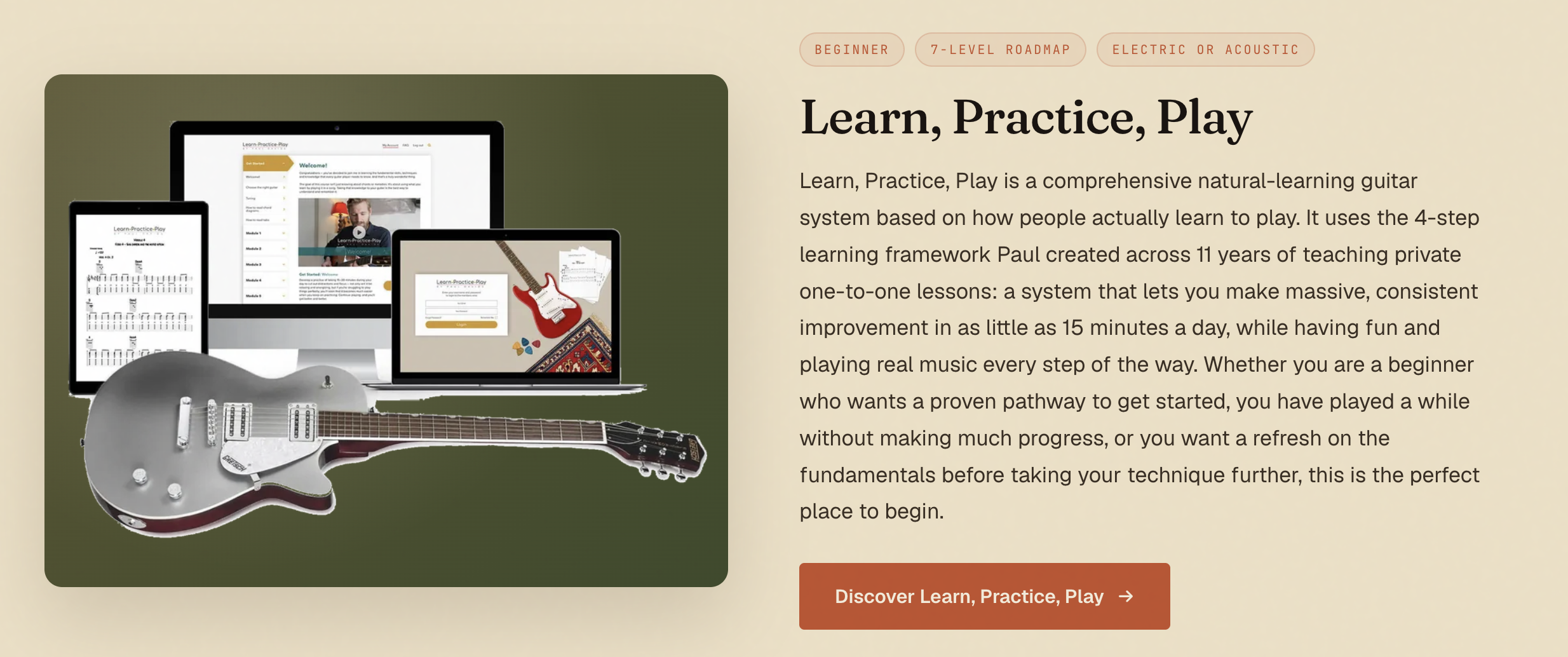
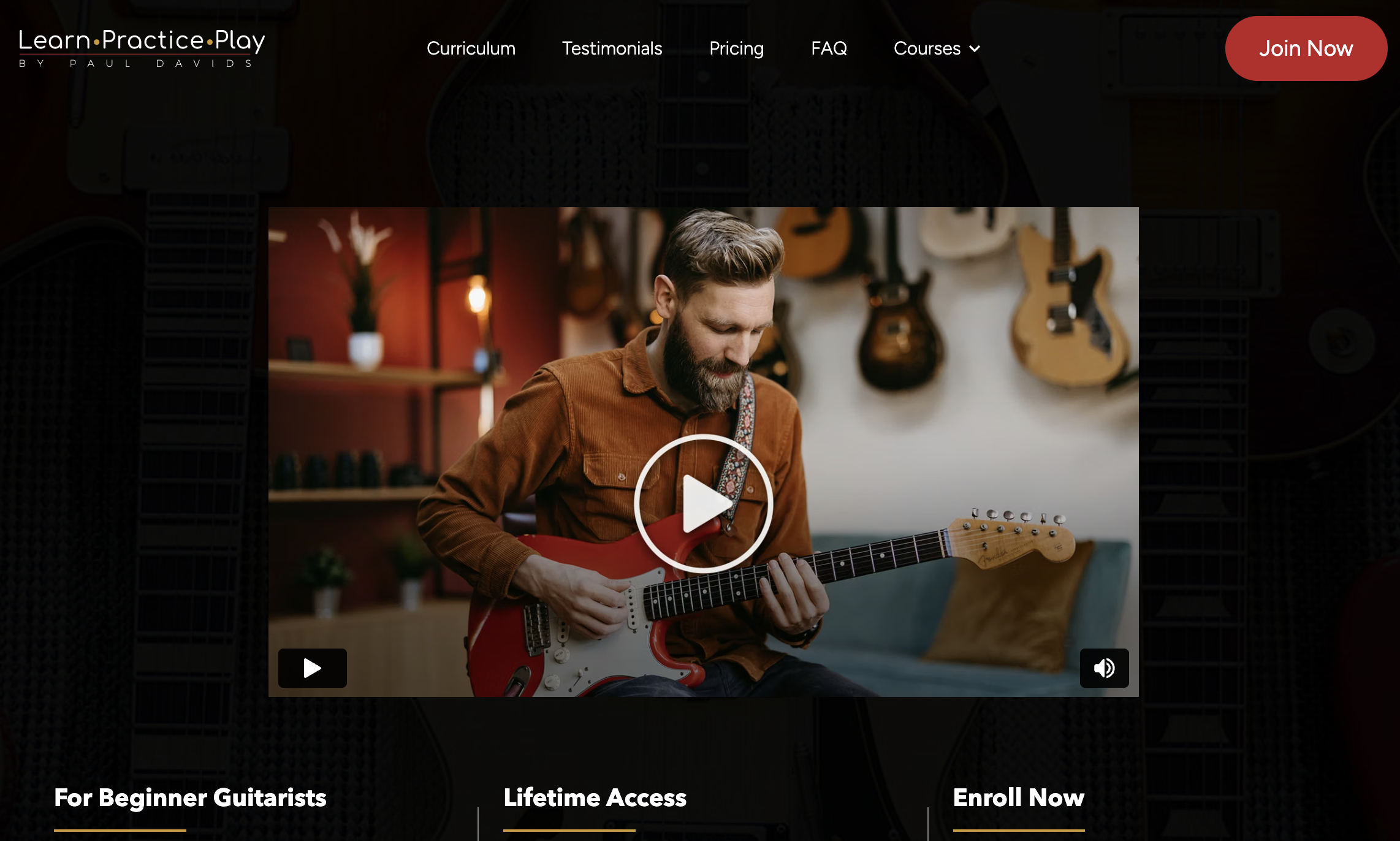
• A late beginner who wants a proper roadmap. Learn, Practice, Play takes you from first chord to real songs over seven modules, with a printable practice schedule.
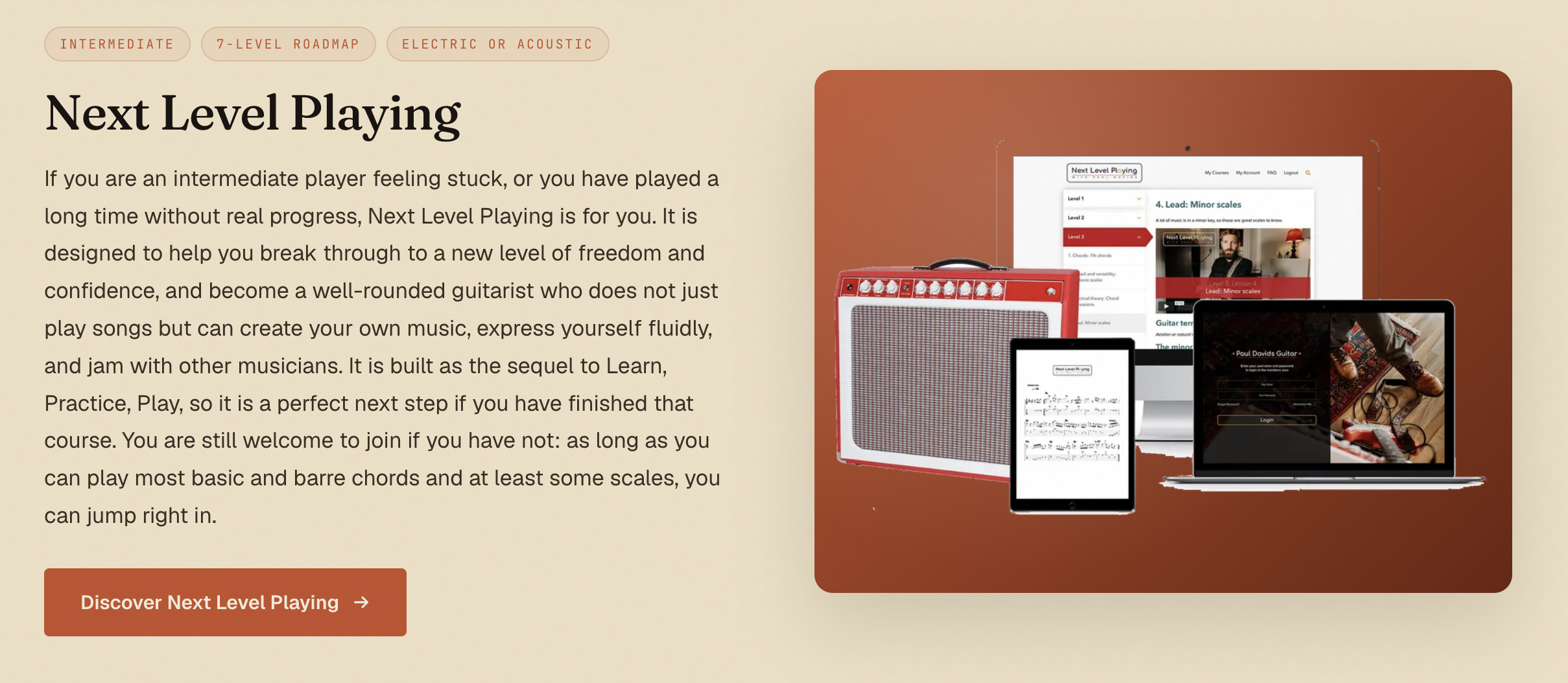
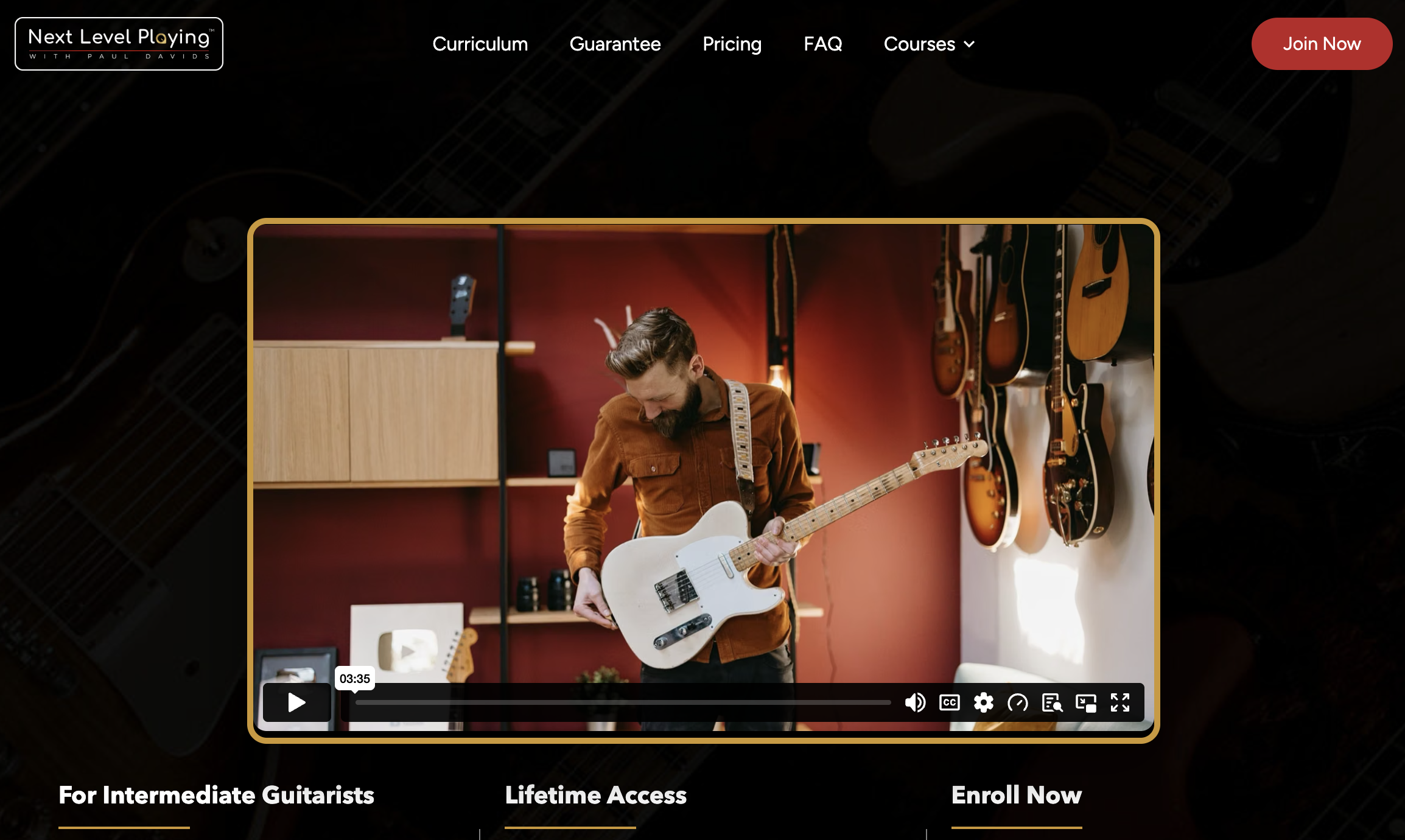
• An early intermediate player who's plateaued. Next Level Playing is the course I bought, and it's the one I'd point most adult players towards. Seven levels cover the fretboard, barre chords, scales, practical theory and improvising, and each level ends with a solo and a Q&A video.
• An intermediate player who knows their scales but can't make music with them. This is exactly who Solo School is aimed at. Rather than giving you more scales, it shows you how players like Gilmour and Knopfler turn a few notes into a solo that says something.
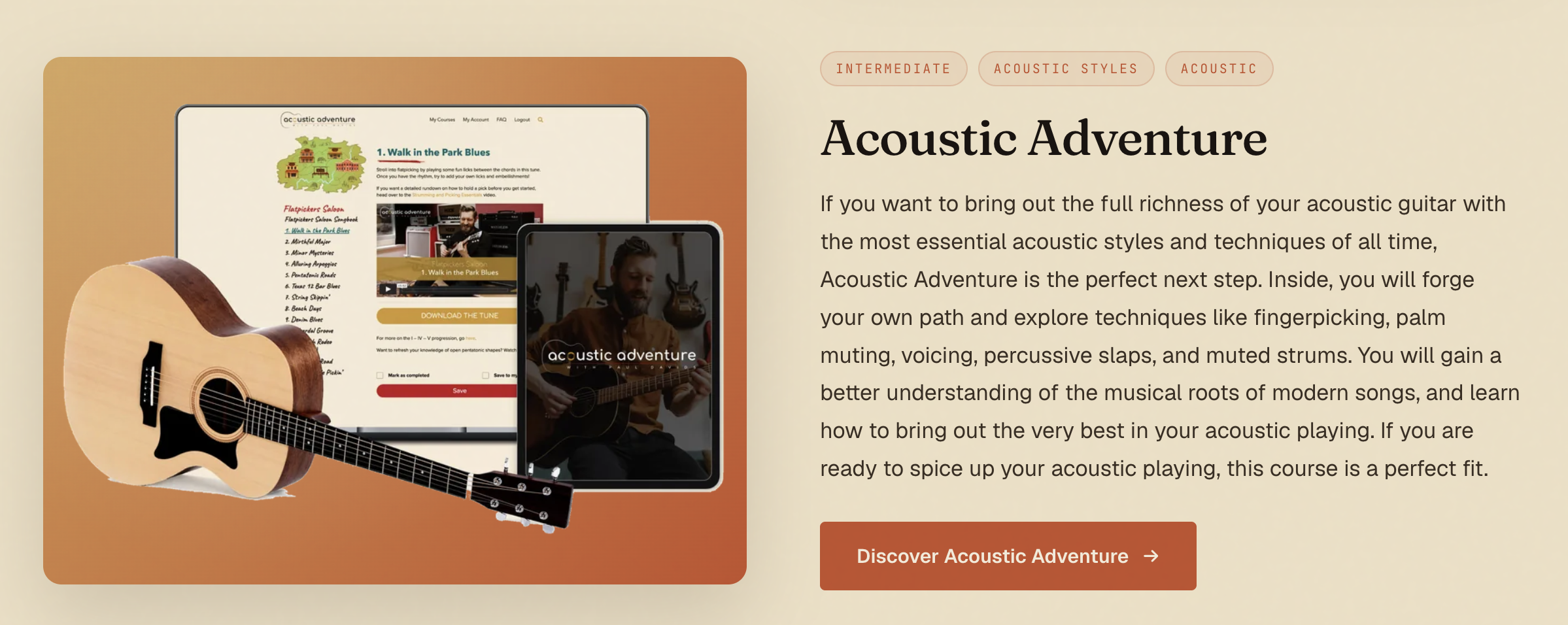
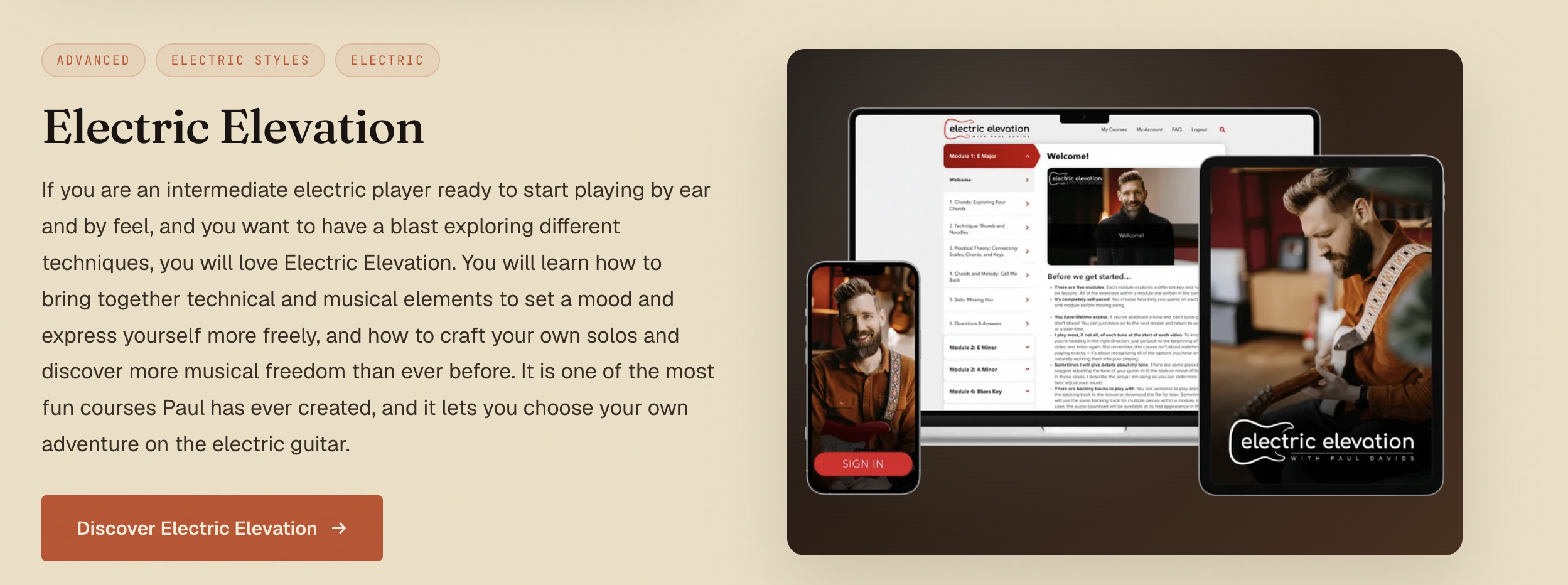
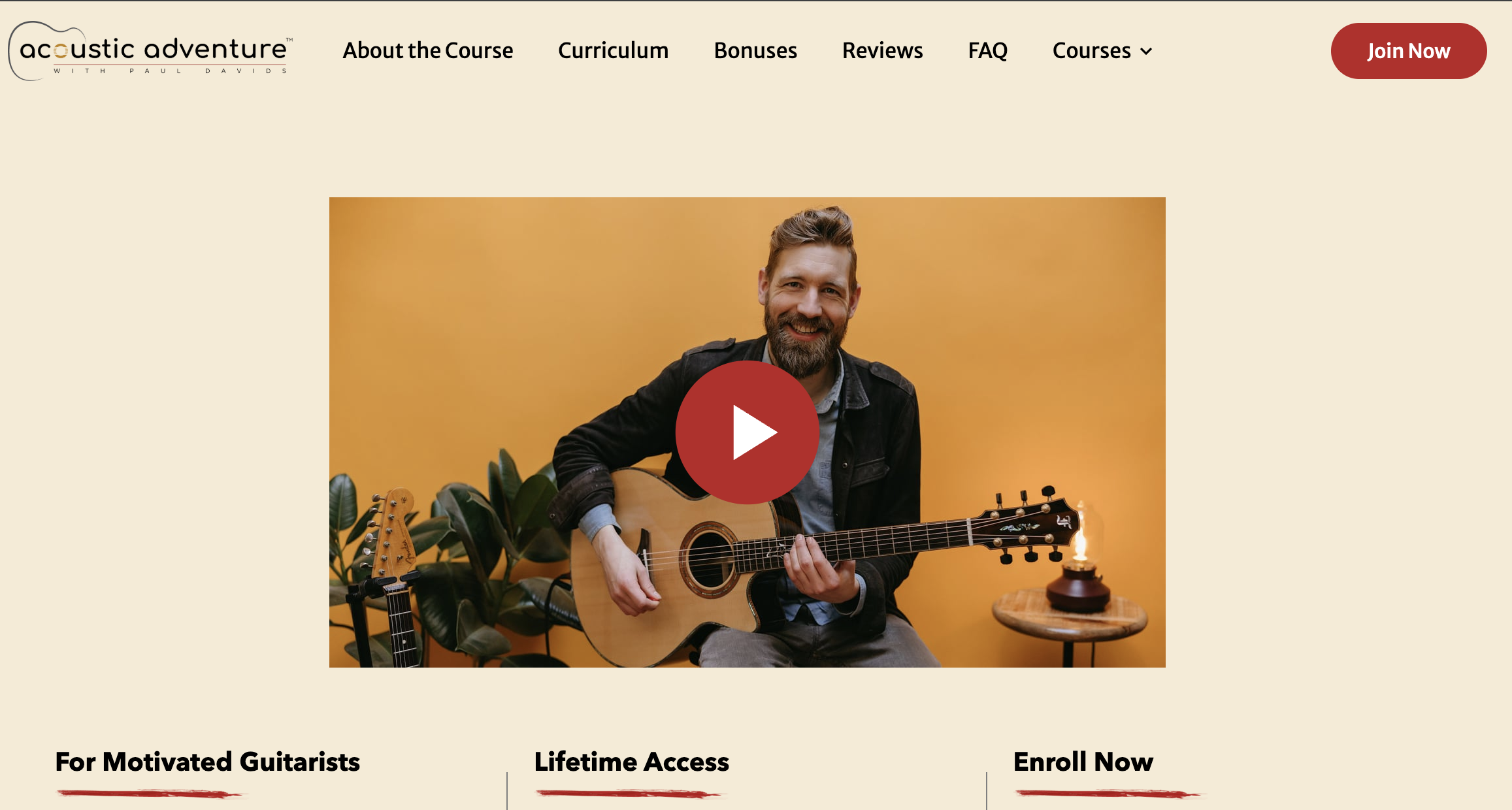
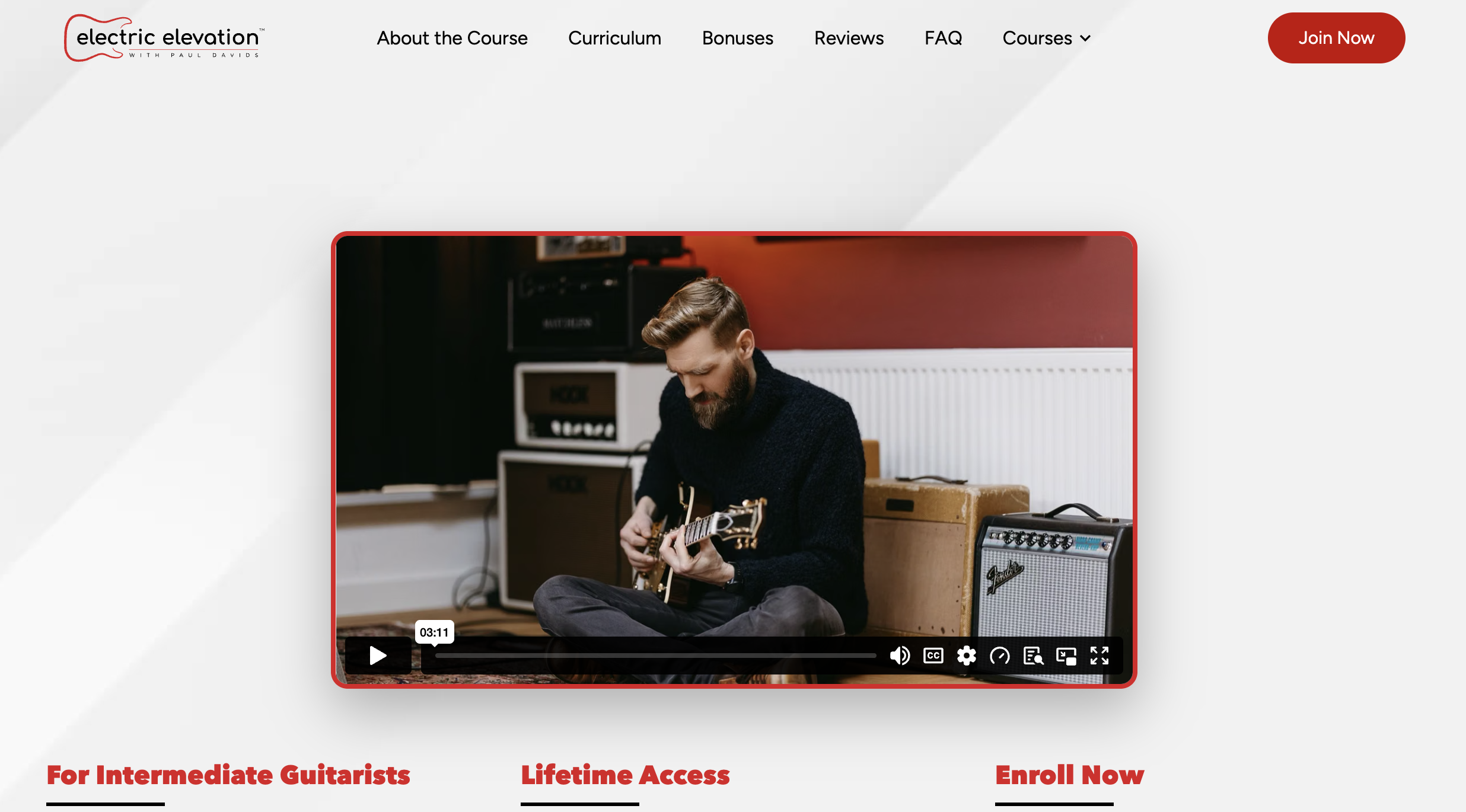
• An intermediate player who wants to elevate their acoustic or electric guitar playing. Acoustic Adventure and Electric Elevation are more targeted intermediate courses to master either the acoustic or electric guitar. These will be the next two courses I’ll buy.
• Someone who already likes Paul's YouTube videos. The courses feel like his channel with more structure: the same calm, friendly, slightly geeky style. If his videos click with you, the courses almost certainly will too.
• A subscription-weary learner. You pay once, there's nothing to cancel, and you can come back to it in five years.
It’s probably not right if you are:
• A song-first learner. These courses use original pieces and solos to teach skills. If your goal is a setlist of songs you already know, Guitar Tricks, Fender Play or Songsterr will suit you better.
• Someone who wants the app to listen to you play. There's no note recognition and no scoring. If you need that kind of feedback to stay motivated, look at the Gibson App or Yousician.
• A mobile-first or offline learner. There's no app, and to protect against piracy lessons can't be downloaded. You need a decent internet connection.
• A classical or notation-first player. The PDFs include standard notation alongside tab, but the courses are built around acoustic and electric styles, not classical repertoire. tonebase is built for that.
• A total beginner who needs a very slow pace. Learn, Practice, Play is good, but some reviewers find the early lessons move a little fast. JustinGuitar's free beginner course is slower and more detailed if you need it.
How the app teaches
Paul's courses fall into two types, and it helps to know which is which before you buy.
The two roadmap courses. Learn, Practice, Play (beginner) and Next Level Playing (intermediate) are step-by-step. Each level unlocks the next, and every level mixes technique, chords, scales, a bit of practical theory and a piece or solo to bring it together. Next Level Playing even asks you to tick a box saying you're ready before it unlocks the next level, and each level ends with a short self-test.
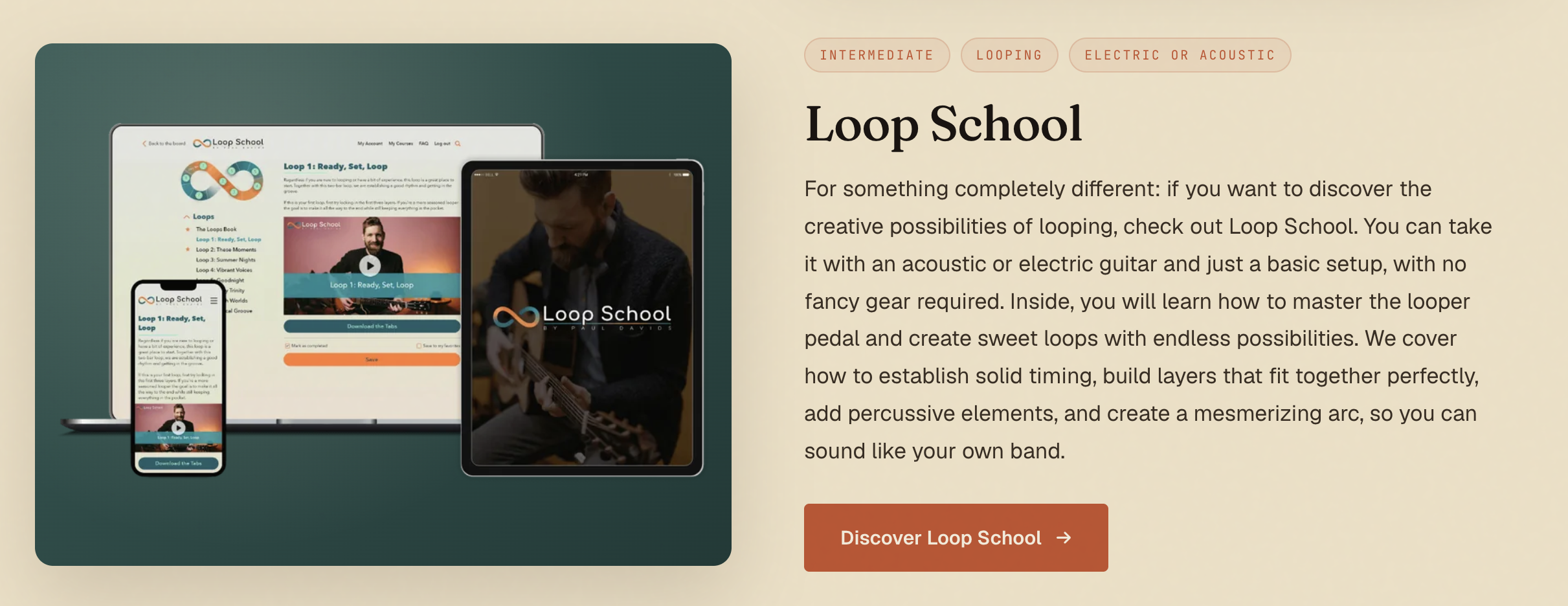
The "choose your own adventure" courses. Acoustic Adventure, Electric Elevation, Loop School and now Solo School are organised around styles or "worlds" you can take in any order. They're better for broadening your playing than for building the basics.
Solo School takes a slightly different approach from his older courses. Paul's idea is that the great players learned by soaking up their heroes' playing, not by studying theory. So each of the five worlds breaks down the signature moves of one player or style (Gilmour's bends and vibrato, B.B. King's "box", Knopfler's chord-tone targeting and fingerstyle, and so on) and finishes with an original solo in that style. The aim isn't to copy their solos note for note. It's to borrow their techniques and use them in your own playing.
Feedback and progress are simple rather than clever. You mark lessons complete and the dashboard shows your percentage. The "Hear Paul Play" buttons let you check your playing against his, and each level has a Q&A video answering common student questions. For human feedback there's a private Facebook group for each course, and the checkout pages now mention "expert guitar-coach support". There's nothing like Pickup Music's video-submission feedback or Guitar Tricks' instructor reviews.
Key features and experience
• Multi-device, browser-based lessons. The course site works well on phones and tablets as well as desktop, and you can be logged in on three devices at once. My setup still works well: the PDF workbook on my tablet, the video full screen on my desktop.
• Workbooks and PDFs. Every course comes with lesson PDFs in tab and standard notation, and Next Level Playing has a printable workbook for each level plus a complete course workbook. This is one of the most useful things about the courses, and something many subscription apps don't offer.
• Backing tracks at two speeds. Slow and full-speed versions for exercises and solos, so you can build up gradually.
• Solo School's new production. Every lesson is filmed from several camera angles with close-ups of both hands, and the tab stays on screen throughout. It also includes:
The Practice Center: 30 guided practice plans for specific skills such as bending, chord embellishments, alternate picking and triads.
Artist Playbooks: how to get close to each player's tone on any budget.
A Backing Track Library: 20 tracks inspired by famous songs, with the chords on screen.
Existing students who joined also got a free Lick Library (listed as a $29 value) to go with the backing tracks.
• Guitar Theory Fast-Track ($79). A new, short theory course in five modules: fretboard notes, intervals, pentatonic and major scales, 7th chords, triads and key signatures. It's taught by a professor of music rather than Paul himself, which is a first for the platform.
• Free tools and guides. The redesigned website now has a free tuner, metronome, chord library and scale finder, plus 68-page electric and 52-page acoustic guitar buying guides and a 30-second quiz that recommends a course. They're worth using even if you never buy anything.
• Community. Each course has its own private Facebook group. I need to correct my 2026 roundup here: there are no forums, open mic nights or live sessions. It's Facebook groups plus recorded Q&A videos.
• A couple of rough edges. The login still lives on a separate site (learnpracticeplay.com), not on the main pauldavidsguitar.com. Lesson pages scroll continuously, so you can lose your place on longer lessons. Bookmark your course homepage.
Strengths
• Teaching quality. Paul explains why things work, not just what to play, and the courses feel calm and encouraging rather than overwhelming. This is still the platform's biggest strength.
• A clear path through each stage. Two roadmap courses plus four style courses (and a theory add-on) means you always know what to do next, which is exactly what most adult learners lack.
• You own it. Pay once, keep it forever. For busy adults who practise in bursts, there's no subscription quietly charging you during the months life gets in the way.
• Practice support built for limited time. Next Level Playing recommends about 90 minutes a week spread over several days, and Solo School's Practice Center is explicitly designed for people with "a few hours a week".
• Excellent printed and downloadable material. Workbooks, tab and notation PDFs, and two-speed backing tracks make it easy to practise away from the screen.
Limitations and trade-offs
• Still no app and no offline viewing. It works well in a browser, but you can't download lessons for a flight or a cabin with poor Wi-Fi.
• Solo School has limited enrolment windows. It opened for five days at the end of September, then reopened for 48 hours for existing students in late October. Paul says it won't reopen until next year. Join the waitlist rather than wait for a "buy now" button.
• No bundle. Buying everything costs over $1,200 at full price, and there's no "all courses" bundle. In my roundup I recommended adding a second course at checkout for 50% off. I couldn't find that offer on the new checkout pages, so don't count on it.
• A short refund window for a long course. Fourteen days is fair for checking whether you like the teaching, but it isn't long enough to know whether a months-long course will stick. Use those two weeks properly (see the routine below).
• Long gaps between new courses, and busy emailing during launches. There was a gap of more than three years before Solo School. And while Paul's emails are friendly and quiet for most of the year, I got around ten in four weeks during the Solo School launch. Not pushy, but worth knowing.
Pricing, trials and value for money
Course:
Learn, Practice, Play (Beginner) - $199 or 3 × $79
Next Level Playing (Intermediate) - $199 or 3 × $79
Acoustic Adventure (Intermediate) - $199 or 3 × $79
Electric Elevation (Intermediate to advanced) - $199 or 3 × $79
Solo School (Intermediate to advanced) - $199 or 3 x $79

Loop School (Intermediate) - $129 upfront only
Guitar Theory Fast-Track (All levels) - $79
• UK and US: everyone pays the same US dollar price. No VAT or tax is added at checkout, so UK buyers pay $199 plus whatever their card charges for currency conversion. You can pay by card, PayPal, Apple Pay or Google Pay.
• Payment plans: 3 × $79 adds up to $237, so paying upfront saves $38 per course.
• Refunds: 14 days on every course, including Learn, Practice, Play (I previously said 30 days for that course; it's now 14). If a course turns out to be the wrong level, the team will swap you to another one within the same 14 days.
• Discounts: public sales are rare. Paul doesn't run Black Friday deals that I could find. The best "deal" I've seen recently was the free Lick Library for existing students joining Solo School.
Is it good value? For one course, yes. $199 is roughly the price of three or four private lessons, for a course that will keep you busy for months. Compared with subscriptions, one Paul Davids course costs about the same as a year of TrueFire or Guitar Tricks at full price, but you keep it forever. The catch is choice: a subscription gives you thousands of lessons, while Paul gives you one carefully planned path. If you'll actually follow that path, the value is excellent. If you like to dip in and out of lots of styles, a subscription will suit you better.
How it fits into a real practice routine
Example 1: the busy late beginner (Learn, Practice, Play, about 2 hours a week)
Mon / Wed / Fri, 20 minutes: one lesson from the current module, using the printable practice schedule.
Saturday, 40 minutes: play through the module's piece with the slow backing track, then the full-speed one.
Sunday: five minutes in the Facebook group, looking at other people's progress videos. It's surprisingly motivating.
Example 2: the stuck intermediate player (Next Level Playing → Solo School, about 90 minutes a week)
Two weekday sessions, 25 minutes each: work through the current level's technique and theory lessons with the workbook open on a tablet.
One weekend session, 40 minutes: play the level's solo with the backing track, then improvise over the same track for ten minutes using only what that level taught.
Once you've finished Next Level Playing: move to Solo School and use one Practice Center plan a week to fix a specific weak spot (bends, vibrato or alternate picking, say) rather than trying to do everything at once.
Making the most of the 14-day guarantee: in your first fortnight, work through at least the first two levels or modules, try the workbook and backing tracks, and decide by day 12. If the level feels wrong, ask the team to swap you rather than giving up.
If you like this, pair it with: a free metronome (Paul's own works well), the free Paul Davids chord library and scale finder for quick lookups, and Songsterr or Ultimate Guitar for the songs you want to play alongside the course work.
Bottom line and recommendation
Try it if you're a late beginner or early intermediate player, you like Paul's YouTube videos, and you want one clear course you can own and work through at your own pace. For most adults who feel stuck, Next Level Playing is still the place to start. Solo School is the natural next step once you know your scales but can't yet make music with them.
Skip it if you want a huge song library, an app that listens to you play, offline lessons, or the variety of a subscription.
Watch out for: the 14-day refund window (use it actively), Solo School's limited enrolment windows (join the waitlist), the separate login site, and checking the checkout page for any add-on offer rather than assuming there's a discount.
I'm still a happy Next Level Playing student, and I'm a better all-round guitarist because of it. Paul knows his audience, makes beautiful lessons, and doesn't try to be everything to everyone. In a market full of subscriptions, that's still refreshing.
Next steps:
• Read my Best Guitar Learning Apps for 2026 roundup to compare Paul Davids with subscription platforms.
• If you want feedback on your playing as well as structured lessons, read my Pickup Music review.
• If you'd rather have a huge library than a single path, read my TrueFire review.
Subscribe to my newsletter to be alerted when new content is added.
Socials: Facebook | Instagram | YouTube
This review reflects Paul Davids Guitar as of October 2026. Pricing, promotions and content counts change often — I'll refresh this as the platform evolves. AI was used in the process of writing this blog post but only to help structure and organise the content.

Frequently Asked Questions
-
No. The courses run in a web browser and work on phones, tablets and computers, but there's no native app and lessons can't be downloaded for offline use.
-
Most courses are $199 (or 3 × $79). Loop School is $129 and Guitar Theory Fast-Track is $79. You pay once and get lifetime access.
-
No, but every course has a 14-day money-back guarantee, and you can swap to a different course within that time.
-
Total beginners should start with Learn, Practice, Play. If you know your barre chords and some scales but feel stuck, start with Next Level Playing. Paul's 30-second quiz on the courses page will point you in the right direction.
-
Solo School is Paul's 2026 improvisation course, built around five "worlds" covering David Gilmour, the blues (B.B. King and Eric Clapton), Mark Knopfler, John Mayer, and Jimmy Page and Slash. It includes a Practice Center with 30 practice plans and a 20-track backing track library. It's sold in limited enrolment windows.
-
Only when enrolment is open. Between windows you can join the waitlist on Paul's website.
-
No tax or VAT is added at checkout. Prices are in US dollars, so your card provider may charge a currency conversion fee.
-
It depends on how you learn. Paul's courses give you one carefully planned path that you keep forever. Subscriptions give you far more content as long as you keep paying. If you want structure and dislike subscriptions, Paul Davids is the better fit.